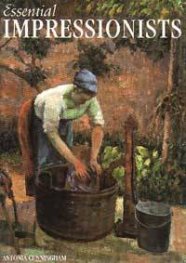
Essential Impressionists
Автор: Мария Андонова
| Издател | Taschen |
| Брой страници | 256 |
| Година на издаване | 2000 |
| Корици | твърди |
| Език | английски |
| Тегло | 1458 грама |
| ISBN | 0752551469 |
| Баркод | 0752551469 |
| Категории | Изобразителни изкуства, Изкуство, Книги |
Анотация
The Impressionists filled the hallowed halls of the French art establishment with light. As a group, they were critically derided, professionally shunned, and considered to be the most outrageous and untalented artists of the 19th century. But they were revolutionary, changing the course of art for ever. Today, less than 150 years later, the paintings of the Impressionists are some of the best-known and most loved works in the entire history of art.
Paris was in the throes of the belle epoque when 19-year-old Claude Monet (1840-1926) arrived from Le Havre in 1859. The economic recession that had been a catalyst for the 1848 revolution was over by 1851, and Napoleon Bonaparte instigated a refurbishment of the city to reflect the prosperity and splendor of the times. Life in Paris changed dramatically, and its streets became a mecca for bright young things, who brought a sense of euphoria into a new cafe society. In such a climate of change, Impressionism should have flourished, but the French people, and the art establishment in particular, were reluctant to embrace its vivacity and refreshing approach to art.
Paintings were expected to be refined and conservative, calling upon Classical traditions and vested with moral rectitude. Art during this time was considered to be a reflection of the spiritual health of the nation. In a time when France was just pulling itself from the depths of spiritual and economic depression, it became all the more important that art was morally upright, honest, and based on a solid foundation of the acceptable and the patriotic.
Like the contemporaries who form the Impressionists, Claude Monet was a man of vision. When he was 18 he met Eugene Boudin (1824—98), and this was reputedly the determining factor in his decision to become a painter. Boudin was a landscape painter, and he painted out-of-doors, documenting with precision and originality the movement of water, air, clouds, and trees. He was extraordinarily influential in Monet"s life, and he is accorded the honor of being the Impressionists" first real inspiration. The academic tradition was strong in the French art world. Success was defined by acceptance at the Paris Salon, a biennial
exhibition, as was a good education at a reputable institution such as the Academic des Beaux-Arts, which also controlled and organized the Salon. The Beaux-Arts was dominated by the great Neo-Classical painter Jean-Auguste-Dominique Ingres (1780-1867), who insisted that everyone must follow his style, with a strong emphasis on formal organization and traditional draftsmanship, copying the Old Masters and drawing with a clear, defined line. Monet grudgingly attended the Academic Suisse, a small, private art school where he met Camille Pissarro (1830—1903), and then entered the studio of Charles Gleyre, a respected master who encouraged individuality. Pierre-Auguste Renoir (1841-1919), Alfred Sisley (1839-99), Frederic Bazille (1841-70), and Monet were drawn to Gleyre"s studio; the four became friends.
Edouard Manet (1832-83), the precursor of Impressionism, came from a prosperous Paris family and sought success in a conventional way, attaining Salon success in 1861 with The Spanish Singer. Pissarro also enrolled at the Beaux-Arts and studied there under landscapist Jean-Baptiste-Camille Corot (1796-1875). Edgar Degas (1834-1917), a close friend of Manet, enrolled at the Beaux-Arts in 1855.
In 1863 the Salon rejected so many submissions that the outcry led Napoleon III (1808-1873) to create the Salon des Refuses, an alternative exhibition where work refused by the Salon could be hung. The exhibition was placed alongside the official show and met with a varied critical response. Manet stole the show with The Lunch on the Grass (1862—63), a summer picnic set in the woods, in which two businessmen are entertaining two nude women of questionable virtue. The painting caused such a stir that it brought him instant notoriety. He became the enfant terrible of the art world, a title that would remain with him for most his career.
In 1865 the Salon opened its doors to the budding Impressionists, showing Degas, Manet, Pissarro, Renoir, Berthe Morisot (1841-95) (who married Manet"s brother), and even Monet, whose landscapes were favorably received. The next six Salon exhibitions marked a period for the artists in which their work was alternatively acclaimed and then cast aside to be exhibited in the Salon des Refuses.
За автора
Коментари
Все още няма мнения за тази книга.
Напиши коментарЩе бъдат допускани само мнения свързани с конкретния продукт или автор.
Ще бъдат изтривани мнения:
- Съдържащи обидно или нецензурно съдържание
- Написани само с главни букви
- Написани на латиница
- Съдържащи препратки към други сайтове.
Други въпроси и мнения моля, изпращайте на [email protected]